Mattress construction · Innerspring mattresses · Care guide
Linked-Spring Mattresses: Structure, Feel, and Care
A linked-spring mattress is built around a simple idea: individual metal coils join together to support the body as a coordinated system. That construction can create a buoyant, responsive feel, but it may also let movement travel farther across the bed. Here’s how to understand the design, what to notice when testing one, and how everyday care can help preserve its support.
What does “linked spring” mean?
A linked-spring mattress—also called an open-coil or continuous-support innerspring mattress—contains rows of metal springs connected to one another. Instead of placing each coil in its own fabric pocket, the maker joins coils with wire, helical connectors, or a continuous wire arrangement. The exact construction varies, but the defining feature is that the springs are not fully independent: when one compresses, neighboring springs may respond too.
That shared movement gives the mattress its recognizable character. The surface can feel lively and quick to respond when someone sits down, changes position, or gets into bed. At the same time, the connected spring unit can distribute pressure and movement across a wider area than individually wrapped coils typically do. Neither quality is automatically a benefit or a drawback. Whether it feels comfortable depends on the sleeper, the spring design, and the layers surrounding it.
“Linked spring” describes the support core, not the whole mattress. A finished bed also includes upholstery, padding, fabric, and often a perimeter or edge-support structure. Those parts influence the first impression—the softness or firmness felt at the surface—as well as how the mattress performs over time.
How the spring system is arranged
Inside an innerspring mattress, coils are organized in a grid beneath the comfort layers. Their number, shape, wire thickness, connection pattern, and tempering all affect how the core responds. A queen mattress may have many hundreds of springs, but coil count alone does not tell you whether a mattress will feel supportive or suit a particular sleeper. Design details and the quality of the complete construction matter more than a single headline number.
Bonnell and other connected-coil designs
Bonnell coils are a familiar linked-spring form. Each coil has an hourglass-like outline, with wider top and bottom sections and a narrower center. Coils are typically joined with wire, helping them work together as a unit. Other open-coil designs may use different shapes or connection methods, including continuous wire arrangements. These variations can change the feel, but the shared principle remains: movement in one part of the core can influence nearby areas.
How linked coils differ from pocketed coils
In a pocket-coil mattress, each spring sits inside an individual fabric sleeve. The pockets help limit direct spring-to-spring interaction, so a coil can respond more independently to pressure nearby. That may reduce the amount of movement felt elsewhere on the bed, although the full mattress still determines the result. Linked coils, by contrast, are mechanically joined and tend to act more collectively.
It is useful to think of these as different construction approaches, not a simple ranking. A well-made linked-spring mattress may suit someone who likes a more buoyant, traditional innerspring feel. A pocketed design may appeal to someone who wants more localized response. Padding, firmness, the bed base, and personal comfort remain part of the decision.
What a linked-spring mattress can feel like
Many sleepers describe open-coil beds as springy, responsive, or easy to move around on. Because the connected coils react as a unit, the mattress may push back quickly as weight shifts. That sensation can feel familiar to people who prefer a classic innerspring surface, especially if the upholstery is not especially thick or plush.
But there is no single “linked-spring feel.” A mattress with a firm spring unit and modest padding may feel quite different from one with the same general coil arrangement and a deeper comfort layer. Materials above the core soften contact, cushion pressure points, and shape the way the body settles. Fabric, quilting, and any additional top layer also contribute to the first impression.
Firmness is not the same as support
Firmness is the surface sensation a sleeper notices when lying down. Support refers more broadly to how the mattress holds the body in a comfortable, reasonably aligned position. A very firm surface is not automatically more supportive, and a softer surface is not necessarily unsupportive. Body shape, weight distribution, sleep position, and personal comfort preferences all affect the experience.
When testing a mattress, give it enough time to settle under your body rather than judging only by pressing a hand into the top. Lie in your usual sleep position. Notice whether the shoulders and hips feel comfortably cushioned, whether the lower back feels supported, and whether you can change position without effort. These are practical observations, not a medical assessment.
Movement across the surface
Because linked coils are connected, a movement in one spot can sometimes be felt elsewhere. How noticeable that is depends on the coil layout, the mattress’s padding, the bed frame, and how much movement is made. A person who sleeps alone may scarcely notice this feature. Bed partners who are especially sensitive to motion may want to pay close attention when trying a mattress together.
Movement transfer is not a defect by definition; it is one possible consequence of a spring system that moves collectively. If minimizing disturbance is a priority, compare the mattress in person when possible, consider how its comfort layers affect response, and look into the seller’s trial and return terms before deciding.
The layers above the coils matter
The coil unit provides a structural foundation, but upholstery and comfort layers create the sleeping surface. These layers may include cotton, wool, foam, latex, or other materials, depending on the model. They help distribute pressure, soften the feel of the springs, and influence temperature and moisture management. A thin comfort layer may let the spring character come through more clearly; a thicker or plusher layer can make the surface feel more cushioned.
This is why a mattress should be understood as a complete system rather than a spring count or a label on a tag. Two beds with linked coils can differ significantly in feel, durability, and care needs because their materials and construction are not identical. Ask what is inside the mattress, whether the layers are fixed or reversible, and what the manufacturer recommends for the foundation and upkeep.
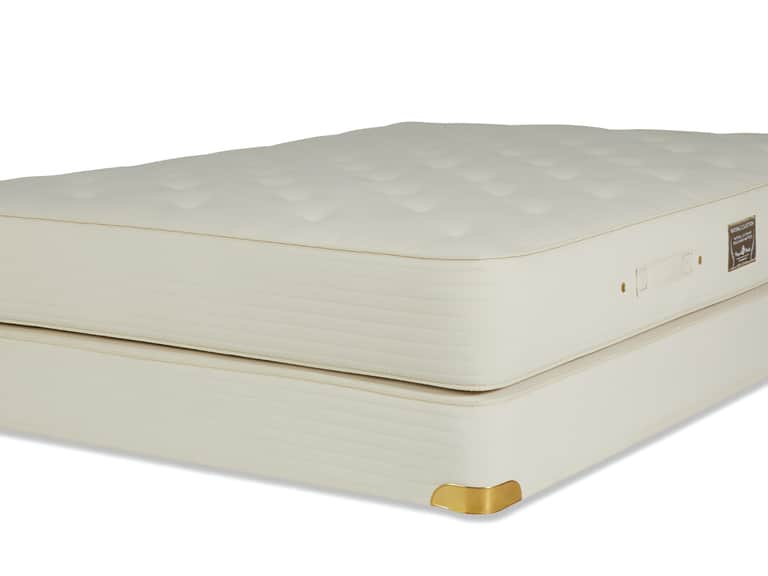
Natural materials can also be part of an innerspring design. For example, the Royal-Pedic Natural Cotton Mattress with Wool Wrap combines an innerspring system with cotton and a wool wrap. Its product details describe a Swiss-designed, double heat-tempered Royal-Flex 650i spring system, along with hand-tufted construction and a firm feel. It is one example of how coil support and upholstery materials work together; it should not be taken as a recommendation for every sleeper.
How to assess support and comfort
Shopping for a linked-spring mattress can be easier when you focus on a few clear questions instead of trying to decode every technical term. If you can test the bed, spend several minutes lying in your usual position and changing positions naturally. If you are buying remotely, look for detailed construction information, care instructions, warranty conditions, and a clear explanation of any sleep trial or return policy.
- Check your usual sleep position. Side sleepers often pay attention to pressure around the shoulders and hips; back and stomach sleepers may be more focused on how the middle of the body is supported. These are general considerations, not rigid rules.
- Notice the transition from surface to support. Ask whether the top feels comfortable while the underlying structure still feels stable.
- Test movement. Roll from side to side and sit near the edge. If sharing the bed, notice how much partner movement you feel.
- Ask about the complete construction. Find out what the comfort layers are made of, how thick they are, and whether the mattress is one-sided or can be flipped.
- Confirm base compatibility. A suitable foundation helps support the mattress evenly. Follow the manufacturer’s instructions for slat spacing, platform beds, frames, or box springs.
- Read the written policies. Warranty coverage and comfort guarantees are not interchangeable, and terms can vary between models and sellers.
If you have persistent pain, numbness, or another health concern, mattress selection is not a substitute for professional advice. Comfort preferences can guide a purchase, but a mattress cannot diagnose or treat a medical condition.
Choosing a base for a spring mattress
A mattress needs an appropriate, stable surface beneath it. A weak, damaged, or incompatible base can allow sagging that affects how the mattress feels and may place uneven strain on its structure. Before setting up a new bed, check the mattress maker’s requirements for the type of foundation, frame, or platform, including any guidance about support spacing and center support.
Slatted bases should be sturdy and evenly spaced according to the manufacturer’s specifications. Larger bed frames may need a central rail and legs to prevent the middle from dipping. A box spring or foundation should also be the right match for the mattress; the term “box spring” is sometimes used loosely, even when a particular support is not designed to flex like older spring foundations.
Make sure the frame is level and that every required support point touches the floor. If a mattress begins to feel uneven, check the foundation and frame as well as the mattress itself. A soft spot or dip may be related to the support beneath the bed, not only to the coils.
Everyday care and routine maintenance
Regular care will not make a mattress last forever, but it can help maintain a clean, well-supported sleep surface. Start with the instructions supplied for your exact model. Materials, quilting, and construction differ, so a routine that is appropriate for one mattress may not be suitable for another.
Rotate only when the instructions allow it
Some mattresses can be rotated head-to-foot to distribute everyday wear more evenly. Others have a designated top and bottom or construction that makes rotation unnecessary. Follow the maker’s schedule rather than assuming every bed should be turned. Rotation is different from flipping: flipping means turning the mattress over, and many modern mattresses are designed to be slept on from one side only.
If rotation is recommended, use the suggested interval and ask for help with a heavy mattress. Avoid dragging it across rough flooring or pulling on handles that are intended only for positioning. A careful two-person lift can reduce strain and limit accidental damage.
Protect the surface and keep it clean
A washable mattress protector can help shield the upholstery from spills, sweat, and everyday soil. Choose a protector that fits the mattress depth and follow its own washing instructions. Sheets should fit without pulling tightly on the corners, especially when a topper or thick comfort layer changes the overall profile.
For routine cleaning, vacuum the surface gently with an appropriate upholstery attachment if the manufacturer permits it. Address spills promptly by blotting rather than rubbing, and avoid soaking the mattress. Excess moisture can be difficult to remove and may affect interior materials. Do not use harsh cleaners, bleach, steam, or heat unless the care guidance specifically allows it.
Give the mattress a supportive setting
Keep the mattress on its recommended base, and periodically check that the frame remains secure. Avoid regularly standing or jumping on the bed: concentrated force can stress components differently from the distributed weight of normal sleep. If the mattress is moved, use a suitable cover and follow the handling instructions so that the spring unit and edges are not bent or crushed.
Signs that deserve a closer look
Over time, a mattress may show changes in comfort. Noticeable sagging, recurring unevenness, unusual noises, or a surface that no longer feels comfortable are reasons to inspect the mattress and its foundation. First check that the frame is level and all supports are in place. Review the manufacturer’s guidance, and document any visible change if you need to contact the seller or warranty provider.
A mattress can develop impressions as materials settle, but what counts as a covered defect depends on the specific warranty terms. Read the conditions carefully: they may define the depth of an impression, require a particular type of foundation, or exclude damage caused by misuse. Keep purchase records and follow care instructions, since both may be relevant to a claim.
Age alone does not give a precise answer about whether a mattress should be replaced. Sleep comfort, physical condition, hygiene, and the manufacturer’s guidance are more useful considerations. If the mattress no longer allows you to rest comfortably, or its support has visibly deteriorated, it may be time to compare replacement options.
Common misconceptions about linked coils
- “More coils always means better support.” Coil count does not reveal everything about wire quality, layout, connections, upholstery, or durability. Compare full specifications rather than relying on one number.
- “A firmer mattress is always the healthier choice.” Firmness is a personal comfort preference, and a firm feel is not automatically the right fit for every body or sleep position.
- “All innerspring mattresses transfer the same amount of movement.” Connected springs may move collectively, but the degree of noticeable motion depends on the entire mattress and how it is used.
- “A mattress should always be flipped.” Some designs are one-sided. Check before flipping; rotating and flipping are different forms of maintenance.
- “The coil unit determines the whole feel.” Padding, upholstery, quilting, and the base all contribute to comfort and performance.
The bottom line
Linked-spring mattresses bring connected metal coils together to create a responsive support core. Their shared movement can offer the buoyant feel many people associate with traditional innerspring beds, while also allowing motion to travel across the surface more than it might in some individually pocketed designs. The finished experience depends on more than the springs: comfort layers, materials, foundation, and personal preference all count.
To choose thoughtfully, test the complete mattress if possible, pay attention to your own comfort in your usual sleep position, and ask detailed questions about materials, movement, and base requirements. To care for it, follow the maker’s instructions, use a suitable foundation, protect the surface, and rotate only when recommended. Those straightforward steps make it easier to understand what a linked-spring mattress can—and cannot—offer.
Quick takeaways
- Linked or open coils connect mechanically and respond as a shared spring system.
- Connected construction can feel lively and may transfer more movement, though the whole mattress affects the result.
- Comfort layers and upholstery shape the surface feel as much as the support core does.
- A compatible, level foundation and manufacturer-approved care routine support long-term upkeep.
- Rotate only if instructed, and do not flip a one-sided mattress.